

Independent excellence
OKAPI:Orbits is a German Space Situational Awareness (SSA) company with a global customer base. We started in 2018 with the core belief that satellite operations can be made safer through a user-friendly but mission-tailored collision avoidance services. Years later, we have expanded our service offering to an end-to-end space situational awareness platform for commercial satellite operators, governments, research institutions and the insurance industry.
We envision a safe and sustainable space environment, truly accessible to everyone.
We watched it happen from a research lab in Braunschweig. Nearly sixteen thousand active satellites now share Earth orbit, roughly eight times the number when we incorporated in 2018, and the warnings arrive faster than anyone can answer them. The science was never the bottleneck. The workflow was. Conjunction data messages compared across separate tools, screening thresholds argued over email, and a maneuver window closing before the team had agreed how to proceed.
So we built the layer in between. Decades of orbital mechanics turned into one clear decision, delivered while the window is still open. That is the whole company.
-
Source: ESA, April 2025.
Give every operator a decision they can defend.
Our mission is to provide Space Situational Awareness that supports transparent, defensible decisions for the organizations operating in an increasingly complex orbital environment.
That begins with data an operator can trust. We build and maintain our own independent catalogue of the space environment. Every value can be traced and checked, so the decision that follows rests on evidence an operator can stand behind, not on a number no one can question.
Five principles that shape how we work.
Customer orientation decides whether the company lasts. Whether or not a role touches the operator directly, the same question applies to the work: does this create value for them? We seek feedback before we need it, and we build the service portfolio with the customers already running on it.
Existing customers shape the roadmap. Relationships hold on transparency, not on promises.
Founded on more than three decades of orbital research

Co-founded OKAPI:Orbits in 2018 and led it from a four-person research spin-off to a team of more than 60. Came to space from industry, with management roles at Siemens and Daimler, including a posting with Mercedes-Benz in Malaysia, before turning a TU Braunschweig research project into a company. Speaks on sustainable spaceflight at forums such as the UN's World Space Forum and chairs the NewSpace sustainability working group at the Federation of German Industries.
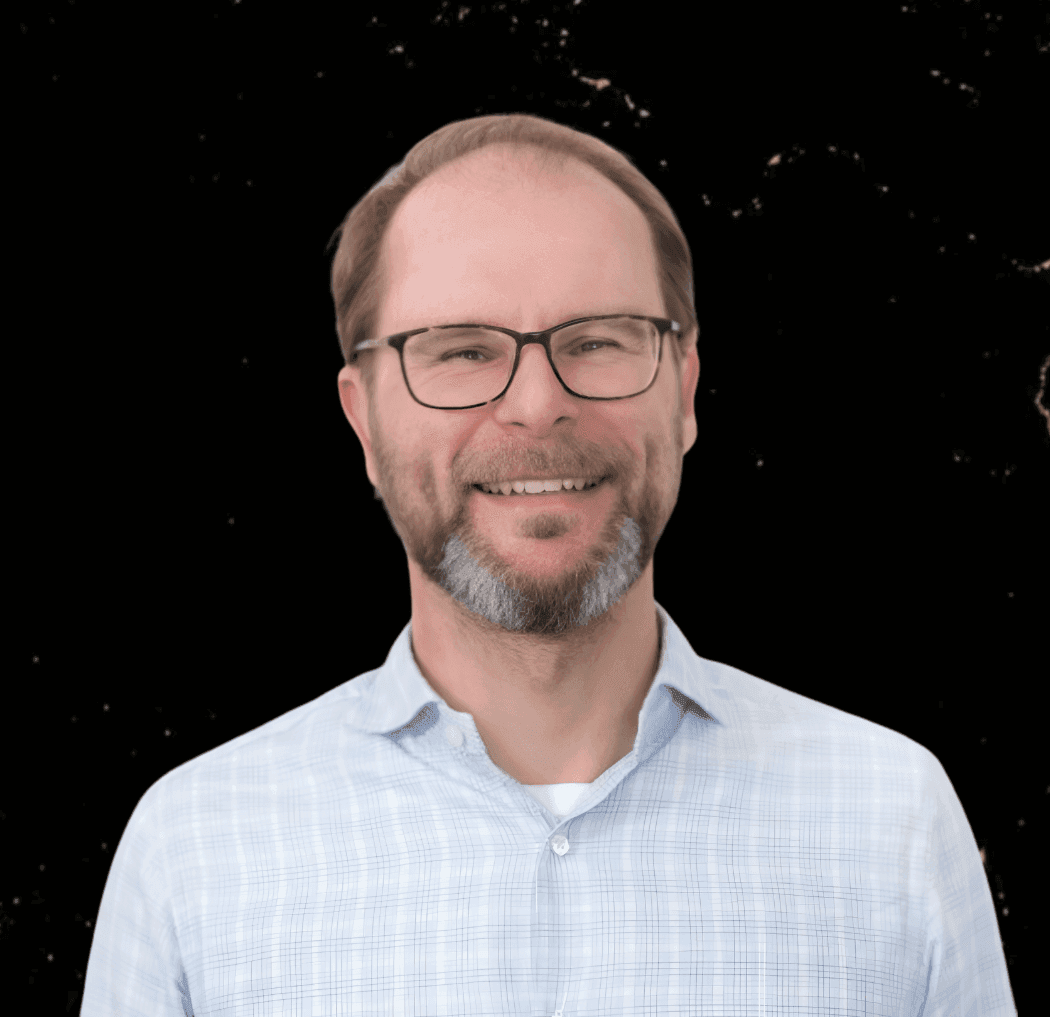
Co-founded OKAPI:Orbits and leads its technology. With a degree in Aerospace Engineering from TU Braunschweig, followed by years as a research associate at its Institute of Space Systems, after global requirements management at Siemens. More than 30 publications on space traffic and space debris; has trained the German military's SSA centre and advises the Space Debris Expert Centre.

From Braunschweig
to the world
OKAPI:Orbits is founded.
Spun out of three decades of debris research at TU Braunschweig. One goal: make space traffic coordination operational, not just theoretical.
Platform ships. Advisory board established.
First platform release brings collision avoidance and monitoring to initial satellite operators, and the first contract with ESA confirms operational readiness.
EUR 5.5M raised.
Seed round closes, led by Munich Re Ventures with APEX Ventures and Dolby Family Ventures. Capital deployed to accelerate the platform and grow the engineering team across flight dynamics and software.
150+ active satellites.
More than 150 active satellites managed on the platform, from single spacecraft to full constellations. Operators such as Astranis screen and maneuver through OKAPI:Orbits, and demand outpaces the original projections.
Catch compliance issues in design, not at licensing.
A new service on the platform moves the hard questions to the design phase, before a satellite leaves the ground: model the mission, size the collision-avoidance maneuvers and delta-V it will need, and check the design against more than 20 debris regulations, including ESA, FCC, NASA ODMSP and the French Space Operations Act. A gap found at licensing can delay or block a launch. Now it surfaces while it can still be fixed.
EUR 10M+ raised.
Seed round of more than EUR 10M, led by Ventech with Matterwave Ventures and the Amadeus APEX Technology Fund. Capital goes into the catalogue, the sensor network and the engineering team.
Flight dynamics as a service.
OKAPI:FDS becomes generally available, putting a full flight dynamics system behind every operator without one. 60+ people, 14+ nationalities. Orbit keeps getting busier, and the team keeps growing with it.